appYuser: As the founder of the Green IT collective and association, and the author of reference works on digital sobriety and ecodesign, you are very familiar with the environmental impacts of digital technology! What are the latest estimates of their scale and how they are changing?
Frédéric Bordage
Our latest studies show that, at every scale — global, European, French, or a company’s information system — digital technology accounts for between 40% and 50% of a European’s annual sustainable impact budget. In other words, 40–50% of the impacts that a European can generate in one year without exceeding planetary boundaries. For our use of digital technology to be sustainable, we need to reduce this proportion by a factor of 10! This is all the more pressing because the environmental impacts associated with digital technology are increasing faster than in other sectors. According to our studies, digital technology’s share of a European’s annual sustainable impact budget has risen from 20% in 2010 to 40–50% today, and will reach around 60% by 2025–2030 if we do not take more effective action.
02
What about awareness among organisations in the digital sector of the need to reduce environmental impacts?
Frédéric Bordage
Greenwashing is now ubiquitous among organisations in the digital sector. 90% of them focus exclusively on greenhouse gas (GHG) emissions, which account for only 11% of the environmental impacts of digital technology in France. Most also use calculation methods that do not comply with standards.
In this context, it is essential to follow international and European standards and ADEME’s methodological recommendations, which converge on conducting life cycle assessments (LCAs) in line with the international ISO 14040 standard (LCA), the European Product Environmental Framework (PEF), and the Product Category Rules (PCRs) defined by ADEME.
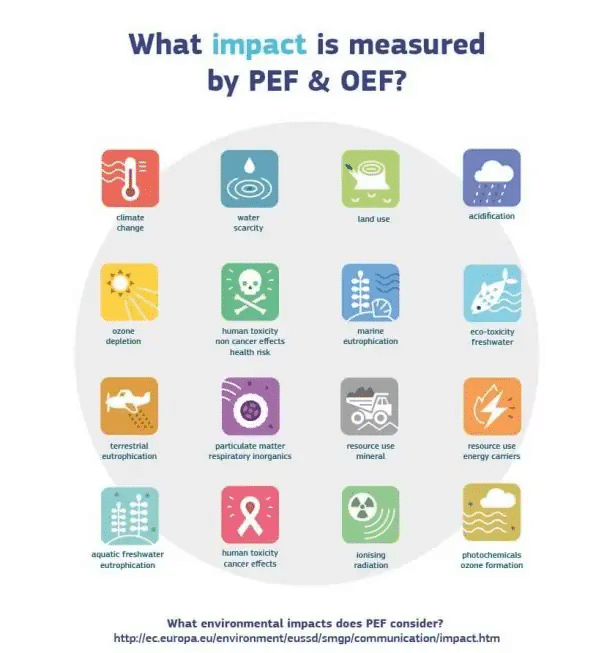
The 16 impacts of the European Product Environmental Framework (PEF). Original illustration in French.
Following these standards and methodologies is no longer optional, as French law is beginning to refer to them. Examples include Article 2 of the Climate and Resilience Act, Article 17 of the AGEC Act and Article 35 of the REEN Act. These regulatory requirements are gradually implementing mandatory environmental labelling for all products and services in France and Europe. Telecoms operators and internet service providers subject to Article 13 of the AGEC Act, and municipalities with more than 50,000 inhabitants subject to Article 35 of the REEN Act, are necessarily more aware of these issues.
Finally, since the publication of the Digital Ecodesign Barometer in France, we have observed that CAC 40 companies and public bodies are seeking to apply ecodesign to their online services, including their websites.
Do website publishers still tend to see reducing their environmental footprint as something too complex?
Frédéric Bordage
There are two groups. The first understands that “environmental labelling for everyone” is on its way and that its framework is based on conducting LCAs. These organisations are a minority, and are ahead in their understanding of market dynamics.
Then there are all those who want to do the right thing, who make up the majority. But, lacking training, they add to the prevailing greenwashing by focusing only on the GHG emissions associated with their website and on superficial good practices that are more about optimisation than ecodesign.
04
In partnership with the AACC, Green IT launched an open “environmental performance label for websites” scheme. What is its purpose? What results have been achieved so far? What are the limitations of this approach?
Frédéric Bordage
The aim of this environmental declaration for websites is to offer a consistent method that enables all publishers of websites and other online services to quantify the associated environmental impacts in the same way and present their results in the same way. This standardisation makes things clearer for internet users, giving them the equivalent of a “Nutriscore for the web”. We are proud to have been the first to offer this type of scheme ten years ago with EcoIndex, and to have reached agreement on it with the AACC, the professional federation for communications organisations and web agencies.
However, this is an interim scheme. In time, the public authorities should clarify the form that environmental performance labelling for websites will take. As part of the European harmonisation currently under way, it will inevitably be based on an LCA and a PCR (see above).
05
One of the keys to achieving a real reduction in impacts is measuring this footprint. A number of tools are now available. What is your view of this field?
Frédéric Bordage
90% of the tools available have three methodological biases serious enough to make them unsuitable for use. Some combine all three!
Firstly, the vast majority focus only on GHG emissions, which represent just 11% of impacts and therefore, by definition, constitute greenwashing. Secondly, some tools assess a website’s impacts based on the amount of data exchanged. This is absurd. Work carried out by operators under Article 13 of the AGEC Act on fixed-line connections (xDSL, FTTH) shows that there is not a strong enough correlation between the amount of data exchanged and the associated environmental impacts. Yet fixed-line connections carry the bulk of data traffic. Many tools implement this linearity bias — indeed, it is their very foundation — leading to far-fetched results.
Finally, other tools rely on assumed electricity consumption. However, software or a web page does not consume energy. The equipment that makes a website possible — servers, routers, computers, screens and so on — consumes electricity. Moreover, two-thirds, or even three-quarters, of the environmental impacts arise from manufacturing users’ devices. Basing an assessment of a web page’s environmental impacts on assumed electricity consumption is methodologically inconsistent.
For all these reasons, following international and European standards is essential to assess a website’s environmental impacts correctly. This inevitably means carrying out a multicriteria LCA, covering 16 impact indicators, as recommended and defined by the European PEF and required by law for operators (Article 13 of the AGEC Act) and local authorities (Article 35 of the REEN Act), and in the future for website publishers.
06
A few months ago, appYuser launched appYplanet, a radically innovative solution for monitoring environmental impacts, as it is the only one to quantify the environmental impacts of websites using the methodologies and standards you mention. And it goes beyond quantifying the carbon footprint. What is your expert view of this new approach?
Frédéric Bordage
Until now, only open-source technology components such as EcoIndex and the EcoIndex.fr service offered an LCA-type approach. Although they can be used in production, they remain technology components that you have to integrate yourself. They are therefore not tools that can be used directly in production.
appYplanet’s first advantage is that it makes it possible to scale up and industrialise the quantification of websites’ environmental impacts without having to integrate technical components yourself.
Another advantage is that you remain in your usual traffic assessment environment. This ease of use, combined with the fact that appYplanet is, at the time of this interview, one of only two tools to follow ADEME and European Commission recommendations, makes it a unique tool on the market.
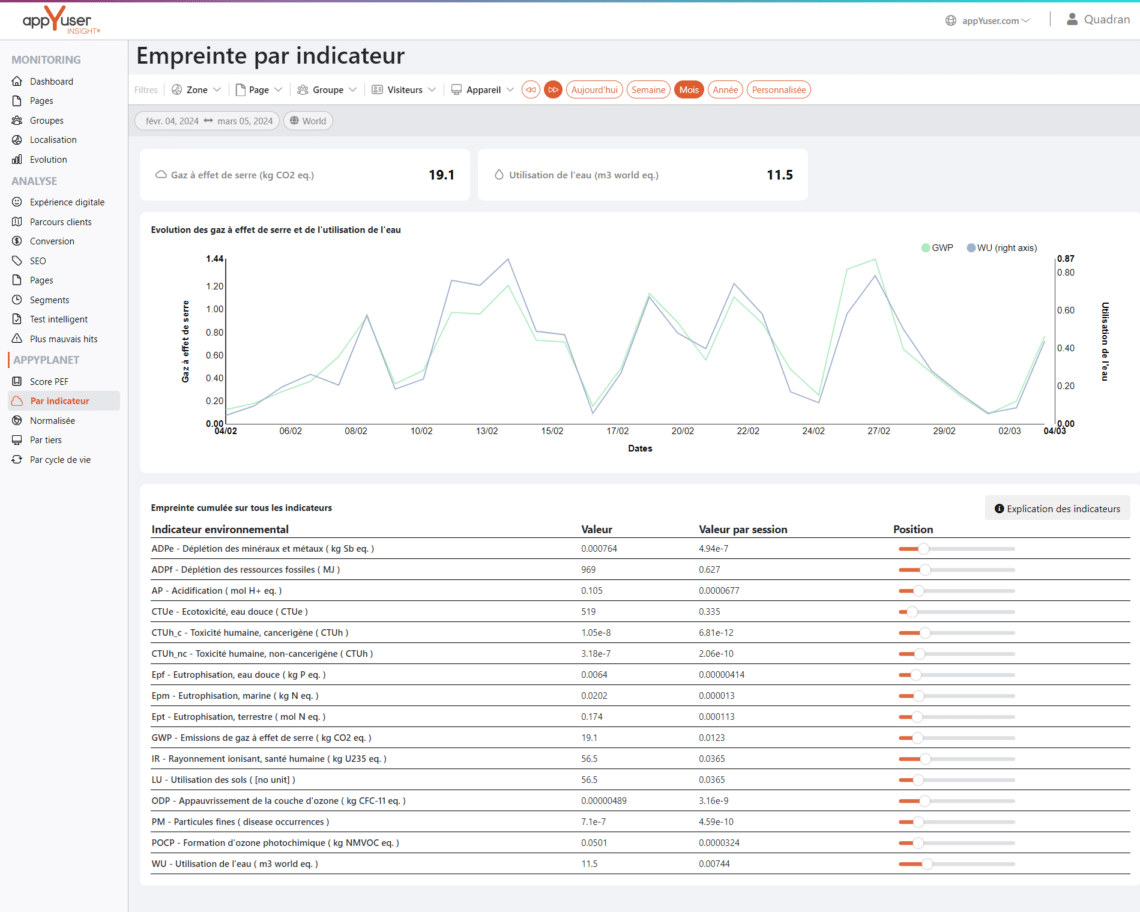
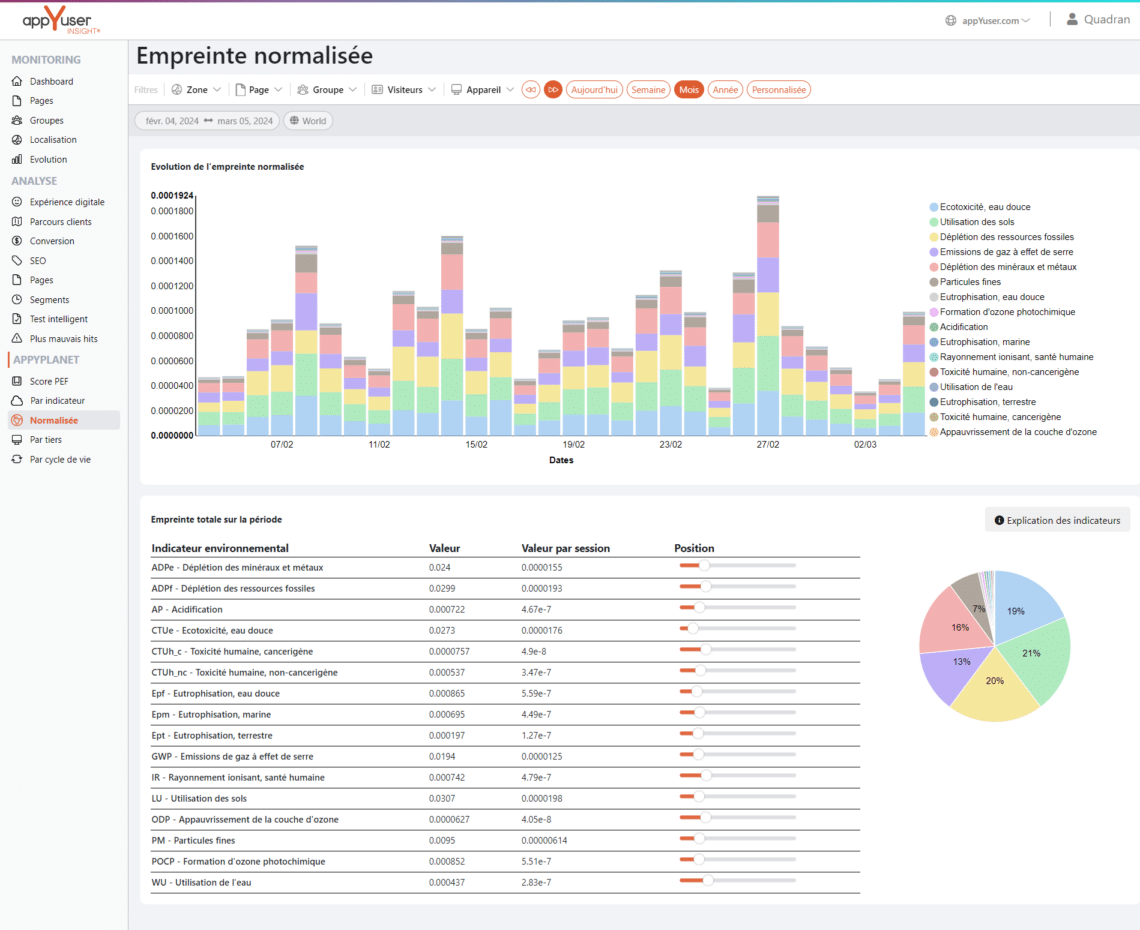
appYplanet: calculation of the different impacts. Screenshot published in March 2024. Original interface in French.appYplanet: normalised footprint. Screenshot published in March 2024. Original interface in French.
Of course, appYplanet reflects the real impacts in production. But it is not merely a passive indicator. For example, the tool makes it very easy to identify the pages or URLs with the greatest impacts. appYplanet is therefore an entry point or a springboard for the ecodesign of your online services. And each change will be taken into account and assessed by the tool.
As an independent expert, I can only recommend using this tool to prepare for the introduction of environmental labelling for websites. appYplanet is ideal for periodically updating your website’s environmental declaration without effort.
Frédéric Bordage — brief biography
A consultant in responsible digital technology, Frédéric Bordage is the founder of the Green IT collective and association. He is also the author of:
Ecoconception web, les 115 bonnes pratiques, Eyrolles, 2012–2022
Sobriété numérique les clés pour agir, Buchet-Chastel, 2019
appYplanet: “a unique tool on the market for assessing the environmental impacts of websites” was last modified: October 20th, 2026 by David Marroncle
Nous utilisons des cookies pour améliorer votre experience de navigation sur le site. Cookie settingsACCEPTER
Cookies et confidentialité
Privacy Overview
Ce site utilise des cookies pour améliorer votre expérience de navigation sur le site. Hors de ces cookies, les cookies classés comme nécessaires sont stockés dans votre navigateur car ils sont aussi essentiels au fonctionnement des fonctionnalités de base du site. Nous utilisons également des cookies tiers qui nous aident à analyser et à comprendre comment vous utilisez ce site. Ces cookies ne seront stockés dans votre navigateur qu'avec votre consentement. Vous avez également la possibilité de désactiver ces cookies. Toutefois, la désactivation de certains de ces cookies peut avoir une incidence sur votre expérience de navigation.
Necessary cookies are absolutely essential for the website to function properly. This category only includes cookies that ensures basic functionalities and security features of the website. These cookies do not store any personal information.