Customer story · appYplanet
How TreCuori measures the environmental impact of its websites
Original interview last updated on By philippe.guilbert
Nicolas Verhaeghe, an environmental engineer at TreCuori, explains in detail how his company has set up a process to measure and reduce the environmental impacts of its websites, and why it chose appYplanet to achieve its ambitious objectives.
Hello Nicolas, could you introduce yourself and explain what TreCuori does?
I trained as an environmental engineer. I have been based in Italy for a few years and recently joined TreCuori, which launched a service dedicated to the environment last July. TreCuori’s main activity is providing employee benefits services and programmes to around 1,300 clients throughout Italy. TreCuori enables companies to offer benefits in the form of an allowance that can be spent on services, most of which relate to wellbeing.
The company was founded in 2013 under a status called Societa Benefit, which requires particular attention to impacts on the local area, both social and environmental, as well as support for the local economy and SMEs.
Can you tell us more about your environmental concerns around your business activities?
We are really at the start of our “environmental journey”. A dedicated environmental department was set up less than a year ago. It currently consists of three people… The company is growing strongly: our workforce has almost doubled in a year. Our environmental impact will inevitably increase.
We started with our main obligation: producing an annual report on our environmental impact. Our aim is always to move towards something more structured and more ambitious. This year, for example, we decided to publish an environmental report that follows the new standard, the new European CSRD (Corporate Sustainability Reporting Directive — editor’s note). This is not mandatory for us; it is a choice the company has made.
Our next objective is to obtain certifications: quality certification, gender equality certification, and B Corp certification, which extends the principles of the Societa Benefit status.
We are a service provider, not a manufacturing company with an industrial process. We therefore want to understand where our environmental impact comes from, so we can measure it accurately and then start taking action to reduce it. Our activities mainly rely on digital tools: four websites, including our corporate website, and a digital platform through which we deliver our employee benefits programmes. Around 20,000 users log into this platform and spend a number of minutes there — quite a long time — choosing the activities on which they want to spend their allowance. We assume this has a significant impact and is most likely the main source of our overall impact. We therefore started looking for tools that would help us measure this impact more effectively.
What difficulties did you encounter in measuring this impact?
It was not straightforward, because this is not my field: my background is in the environment. We had to familiarise ourselves with this new discipline of digital sustainability, bringing together two worlds: environmental impact assessment and digital technology. Which aspects of digital technology generate the impact? What is the scale of this environmental impact?
I cannot remember the exact reference, but the internet could almost be considered the fourth highest-emitting continent. I think there is a growing awareness of this impact, which began with data centres that need a lot of energy for operation, storage and cooling.
But we struggle to take all the other aspects of using digital services into account… What makes this even harder is that information is very scattered. There are no international standards or rules that give access to methods for measuring and understanding this impact, or even make clear the scope to which those methods apply.
How do you find your way through all the measurement solutions?
First of all, the rules have changed. The European Parliament is in the process of legislating on new communication rules: how environmental claims and declarations must be communicated… Looking at the wide variety of tools and even labels I had seen, I sensed a risk. Some options are very appealing because they seem simple, quick and inexpensive, and let you communicate immediately on your website.
But the new rules now require you to follow precise rules: you have to carry out a calculation and be able to provide evidence for it…This made us very cautious about what we would choose to do. Although we initially did not yet know how far to go or which method to apply, we wanted assurance that the calculations and methodology were robust and the data transparent. If you want to communicate, and if you want to act and take specific steps to reduce your environmental impact, you need an accurate measurement.
How did you identify and categorise the different solutions?
We worked in two stages. First, we reviewed the state of the art: existing research, methodologies, standards, laws and rules. We also sought advice from specialists and carried out market research on the available tools. We asked ourselves the following questions: how accurate are the calculations? Which standard is followed? Is the methodology accessible? Is it understandable? Although we understand that the full details of the calculation algorithms cannot be disclosed, understanding the method and calculation rules is essential for us to assess a tool’s quality.
We carried out this research across three markets: the Italian national market, the French market and the international market. I think we reviewed a lot of tools… And it is far from simple!
For a start, some tools do not really give the same result for the same page. Then the scope of the calculation is not always clear: does it apply to a single web page or an entire website? How can the impact of an entire website be quantified simply by entering a URL?I have to say that we had to do a lot of “navigating”, especially in France… The sheer number of tools is rather dizzying, and we had not expected it to be so complicated to measure our environmental impact. We came to understand that this is a very new discipline in which the rules are not yet clear. So you find all sorts of calculations and methods on offer. We needed to establish quality criteria for selecting a solution, because we could not afford to embark on a calculation that was only half done. If you are going to do something, you might as well do it properly from the start!
Why did you choose appYplanet over the other solutions?
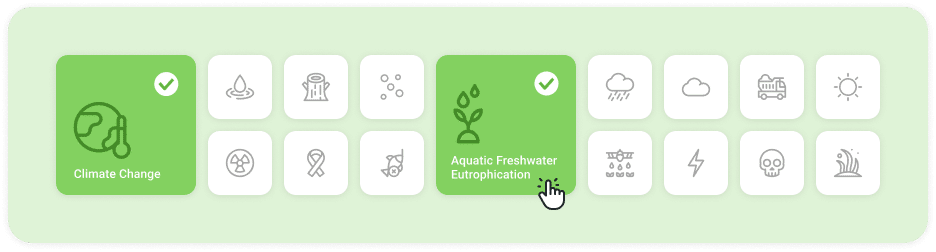
Finding appYplanet was a pleasant surprise. What immediately struck me was that the tool draws on some of the most rigorous standards for environmental impact assessment, including life cycle assessment: taking into account the impact of a product and its different components from their origins through to the end of life. It also applies the European “Product Environmental Footprint” standard. These two criteria were quite decisive.
Another very interesting aspect was how appYplanet was developed, bringing together the experience of IT experts and environmental experts specialising in the environmental impact of digital technology. What is more, appYplanet draws on the results of research projects carried out rigorously, such as the NégaOctet database of emission factors specific to digital technology. There is also a desire to develop knowledge about the impact of digital technology, including the fact that it is based on a study conducted with the Swiss Federal Institute of Technology in Lausanne…
This whole process of learning, accumulating knowledge, sharing knowledge between different participants and bringing together knowledge from the digital world and environmental assessment gives a fairly robust basis to the methodology and tool that have been developed.
Then, on the digital side, appYplanet uses data measured in real time: traffic, where connections originate, the types of devices visitors use… All of this makes it possible to obtain fairly detailed data.There is another aspect we had not considered but which played an important role in our decision to choose appYplanet: the respect for privacy made possible by the fact that the solution does not require cookies to be installed. Our clients’ data concerns their employees, so it is particularly sensitive. We therefore need a very high level of security. The fact that the data is stored in France provides an additional assurance of security.
The transparency appYplanet offered from the outset, both on the IT side and in its environmental expertise, was particularly appreciated. It enabled us to have in-depth discussions and get answers to our technical questions.
Last but not least, appYplanet is easy to install. Configuration does not take too long and does not require an investment from our IT teams.
What did you discover after a few weeks of using appYplanet?
Specifically on the environmental side, I have to say that we did not expect emissions on this scale. We had a feeling that this aspect of our activities would be among the largest sources of emissions, and therefore of impact. That feeling has been confirmed, but the scale surprised us. Admittedly, our services require users to stay connected for quite a long time and navigate between different providers and pages, but we had not expected such a significant impact.
The second thing we appreciated was having very precise data on traffic, connection times and the performance of individual web pages… This already gives us an idea of where to focus our efforts to improve navigation and the overall user experience. That is essential for us, because we must not discourage our users!
Combining appYplanet with appYuser will enable us to identify the specific areas where we can improve and take action quite quickly.
What are the next steps for TreCuori on this project?
First, we will finish building a reliable baseline: we will continue monitoring our environmental impact for a while longer. Then, using the results, we will be able to identify the specific areas I mentioned earlier — the pages and particular issues that hinder navigation — where we can immediately take action to improve things.
Improving navigation performance will also improve our environmental impact. We will then measure the reduction in impact brought about by these improvements. From there, our aim is to offset emissions that are difficult to reduce. We then want to make sure we can communicate without risking greenwashing, because we are using a tool that tracks real-time data and follows recognised standards!
Many thanks, Nicolas, for this insightful interview!